
“Sunday morning works for us” sounds like an agreement until another household pictures Sunday morning on its own clock. A family call needs one shared moment, with a clear local date and time for everyone joining.
Start with the people, then work out the clock labels. A free square on a calendar does not tell you whether someone wants a call, can find a quiet spot, or has enough time to talk. A short conversation about those things belongs before the invitation.
If you found this guide through Hey Nestie, meet Nestie, the assistant within Nestify. The call card below works in a message or on paper, too.
Start with two places and two workable windows
Ask each household for the city where they will actually be on the call date. A relative who normally lives in London may be visiting somewhere else that weekend. Use a city and country when a place name could be ambiguous.
Then ask for a comfortable window in that household’s local time. “We could talk after breakfast, but we need to leave soon afterward” is useful context. Turn it into a proposed time together; avoid deciding for them what “after breakfast” means.
You can start with four questions:
- Where will you be that day?
- What local date and time could work for you?
- How long would you like to talk?
- Would you prefer a call, a voice message, or another day?
Treat “maybe” as an open question. If a child might join, let the adults arrange a flexible invitation rather than promising the child will stay for the whole conversation. Someone can say hello briefly, listen, or leave the adults to catch up.
Here is a fictional example we will use throughout. One household is in Los Angeles and another is in London. They want to try a twenty-minute call on October 25, 2026. The Los Angeles household proposes 9 a.m. The London household says late afternoon could work, provided they finish before starting dinner.
Those preferences are invented for this example. They are not recommendations for anyone else’s family. At this point, the candidate needs a dated conversion and an answer from both households. Nobody has agreed merely because the proposed time sounds plausible.
If the windows do not overlap comfortably, take the pressure off. Ask whether another day or an exchange of recorded messages would suit people better. You do not need to force this call into the first available gap.
Check the offset for the date of this call
Choose both cities and the call date. Timeanddate’s meeting-planner help explains why daylight-saving changes can affect the difference.
The fictional example falls on a clock-change weekend. GOV.UK says UK clocks go back on October 25, 2026, returning to Greenwich Mean Time. NIST gives November 1 as the 2026 end of U.S. daylight saving, while noting that some locations do not observe it.
For this specific call, the checked conversion is:
Sunday, October 25, 2026: 09:00 in Los Angeles (PDT) = 16:00 in London (GMT).
That is 9 a.m. for the Los Angeles household and 4 p.m. for the London household, on the same Sunday. Both labels describe the start of one call. They are not two appointments.
Read the local date as carefully as the time. For other city pairs or candidate hours, the same moment can fall on different calendar days. A message that says only “Sunday at four” leaves too much for the other person to infer.
Keep the city names beside the numbers when sharing the result. Abbreviations can be a useful extra label, but “Los Angeles” and “London” make the example easier to recognize. Write either a.m./p.m. or a clear 24-hour time consistently.
If someone changes the call date, check the conversion again. The result above belongs to that date. For a future recurring call, agree which household’s local time should stay convenient, then check proposed dates before treating the arrangement as settled.
Share a call card everyone can read
Once both households accept the candidate, put the agreement in one place. Here is the completed fictional card. The duration, availability and fallback are household choices; the two local start times are the verified conversion.
| Call detail | Fictional agreement |
|---|---|
| Los Angeles start | Sunday, October 25, 2026, 09:00 PDT |
| London start | Sunday, October 25, 2026, 16:00 GMT |
| Duration | Twenty minutes |
| Los Angeles window | After breakfast, before leaving home |
| London window | Late afternoon, finishing before dinner preparation |
| Date-specific conversion | Checked for the date shown above |
| If someone cannot join | Send a message; offer another day without expecting an immediate reply |
Ask each household to say back its own start time: “Yes, Sunday at four here in London works.” This is also a chance to correct a mistaken date or decline. Sending the card alone does not establish agreement.
For your own call, copy these blank fields and fill them together:
- Household A: city, local date and start time: ______
- Household B: city, local date and start time: ______
- Comfortable duration and each household’s available window: ______
- Conversion checked for this date using: ______
- Each household has agreed: ______
- If plans change, contact ______ by ______
Read the card aloud for relatives who prefer a spoken arrangement. Keep an uncertain field blank until someone answers it.
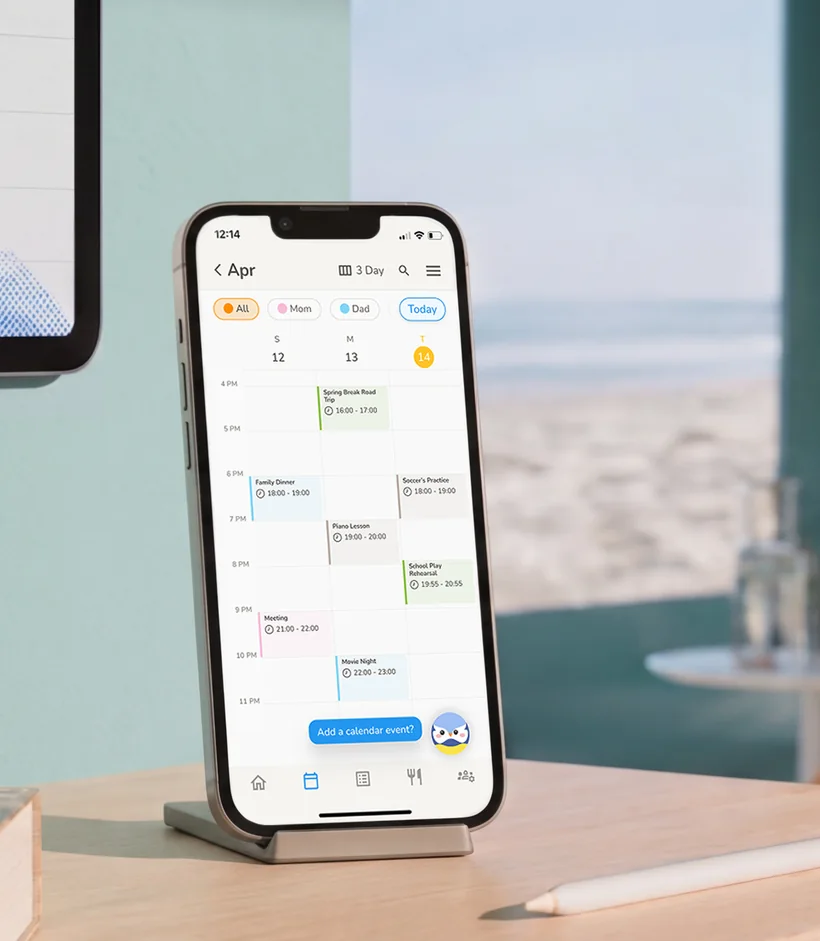
After agreement, you can manually record the call in Nestify’s Calendar with a title, start and end times, and a description. Put the shared call card in the description if useful. The calendar-request guide covers preparing the event details once the time is settled.
Before ending the planning conversation, leave everyone with one agreed date and a simple way to change plans. The invitation should make room for the people you hope to hear from.